

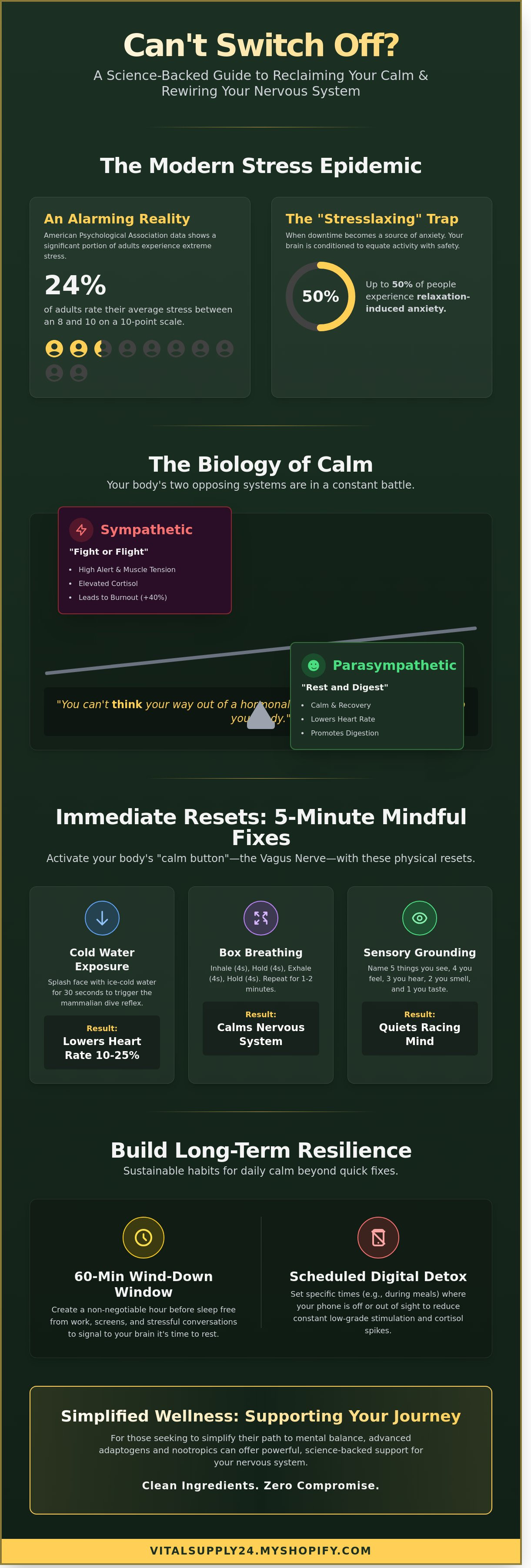
What if your inability to "switch off" isn't a lack of willpower, but a physiological state your brain simply can't escape? Data from the American Psychological Association's 2023 Stress in America survey shows that 24% of adults rate their average stress between an 8 and 10 on a 10-point scale. It's exhausting to carry a permanent knot in your shoulders while feeling guilty for every minute you aren't being productive. You've likely searched for how to relax only to find your mind racing the second you turn out the lights. We understand that frustration. Your body is stuck in "high alert" mode.
You deserve a reliable way to hit the reset button. This guide offers a science-backed, simplified checklist designed to recalibrate your nervous system and restore daily calm. We'll cover immediate techniques for acute relief, a repeatable routine for lasting resilience, and the specific role of advanced supplements in supporting your path to tranquility. Clean ingredients. Zero compromise. Ready to feel the difference? Let's begin.
Key Takeaways
- ✓ Identify the "stresslaxing" trap and understand why your brain often resists downtime when you need it most.
- ✓ Master how to relax by signaling your nervous system to lower cortisol through physical, science-backed resets.
- ✓ Implement immediate 5-minute techniques like sensory grounding and box breathing to instantly quiet an "always-on" mind.
- ✓ Build long-term resilience with a 60-minute wind-down window and digital detox periods for sustainable daily calm.
- ✓ Discover how advanced adaptogens and nootropics can simplify your path to mental balance. Clean ingredients. Zero compromise.
Understanding the 'Stresslaxing' Trap: Why You Can't Unwind
Learning how to relax is often harder than the work that precedes it. You finally sit down to rest, but instead of feeling calm, your heart races and your mind cycles through tomorrow's deadlines. This phenomenon is known as "stresslaxing." According to a study published in Psychological Reports, between 30% and 50% of people experience relaxation-induced anxiety. It happens because your brain has been conditioned to equate constant activity with safety and success. When you stop moving, your "Always-On" internal monitor views the silence as a threat to your productivity, triggering a wave of guilt.
Breaking this cycle requires a fundamental shift from "doing" to "being." Mental health isn't a task you can check off a list; it's a physiological state you cultivate. In a high-pressure environment, your brain needs permission to disengage without feeling like it's falling behind. Our goal is to provide a simplified path to resilience that fits into a schedule that never seems to stop. True recovery happens when you stop treating rest as a luxury and start seeing it as a biological necessity.
The Science of the Modern Stress Response
Your body operates on a biological seesaw between two states: the Sympathetic Nervous System (Fight or Flight) and the Parasympathetic Nervous System (Rest and Digest). In 2023, clinical data showed that chronic over-activation of the stress response leads to a 40% increase in reported burnout symptoms among professionals. The Sympathetic Nervous System keeps your body in a state of high alert, maintaining muscle tension and elevated cortisol levels long after the workday ends. Willpower alone isn't enough to force relaxation because you can't talk your way out of a hormonal surge. You have to signal to your nervous system that the "predator" of your inbox is no longer a threat.
Why Forced Relaxation Often Backfires
Attempting to "quiet the mind" while it's still racing is like trying to stop a train by standing in front of it. When you set unrealistic goals for your downtime, you inadvertently turn rest into another source of performance anxiety. This creates a feedback loop where you feel stressed because you aren't relaxing well enough. Common pitfalls include:
- The To-Do List Trap: Adding "meditate for 20 minutes" to a list of 15 other chores.
- The Comparison Game: Feeling inadequate because your "zen" doesn't look like a social media post.
- The Efficiency Obsession: Trying to optimize your rest for maximum ROI.
The VitalSupply24 Promise is different. We simplify the path to calm by focusing on science-backed methods that work with your biology, not against it. We believe in effective, no-nonsense solutions for the modern achiever. Understanding how to relax shouldn't be a source of stress. Ready to feel the difference? Let's move from theory to practice. Simplified.
The Biology of Calm: How to Relax Your Nervous System
True relaxation isn't a state of mind; it's a state of biology. Many beginners struggle because they try to "think" themselves into a state of peace while their bodies are still stuck in a fight-or-flight loop. Physiological resets are significantly faster and more effective than psychological ones for immediate relief. When your heart rate is elevated and your muscles are primed for action, your brain stays on high alert. You must signal safety to the body first. Clean Ingredients. Zero Compromise. This mantra applies to your internal chemistry just as much as it does to your supplements. To master how to relax, you must learn to speak the language of your nervous system.
Activating the Vagus Nerve for Instant Relief
The Vagus nerve is the literal "reset button" for your internal calm. It's the longest cranial nerve in the body, acting as a two-way highway that carries 80% of the sensory information from your organs to your brain. Stimulating this nerve sends an immediate signal to your heart and lungs to slow down. You can trigger this response through simple physical actions:
- Cold Water Exposure: Splashing ice-cold water on your face for 30 seconds activates the mammalian dive reflex, which can lower your heart rate by 10% to 25% almost instantly.
- Vocal Stimulation: Humming, singing, or chanting vibrates the vocal cords, which are directly connected to the Vagus nerve path.
- Gut Optimization: Since 90% of your body's serotonin is produced in the digestive tract, maintaining a healthy microbiome is essential for a relaxed mind.
Managing Cortisol: The Body's Stress Command Center
Cortisol acts as the body's stress commander. In short bursts, it's life-saving. However, chronic high cortisol levels prevent deep cellular repair and keep your mind in a state of perpetual "scanning" for threats. This hormonal imbalance is often exacerbated by modern environmental factors. Blue light from screens can delay melatonin production by up to 90 minutes, keeping cortisol levels artificially high well into the evening. Caffeine also plays a role. With a half-life of roughly 6 hours, a cup of coffee at 3:00 PM means 50% of that stimulant is still circulating at 9:00 PM. For a comprehensive strategy on balancing these hormones, read our guide on Stress Management.
Understanding how to relax is about reclaiming control over these biological levers. When you prioritize physical calm, mental clarity follows naturally. Simplified. Ready to support your body's natural recovery processes? View our curated wellness supplies to find science-backed tools for your daily routine.
The Immediate Relaxation Checklist: 5-Minute Mindful Resets
Learning how to relax doesn't require a weekend retreat. Resilience is built in the five-minute gaps between meetings and the small windows of your morning routine. High-performance living requires a "simplified" approach to recovery. Use this checklist to reset your nervous system when the cognitive load becomes too heavy.
- ✓ 5-4-3-2-1 Sensory Grounding: Use your environment to exit a spiral of intrusive thoughts.
- ✓ Box Breathing: Follow a 4-4-4-4 cadence to stabilize your heart rate.
- ✓ The Brain Dump: Transfer every stressor from your mind to paper to clear working memory.
- ✓ Progressive Muscle Relaxation (PMR): Systematically release physical tension from head to toe.
A 2023 study published in Cell Reports Medicine found that just five minutes of daily breathwork improves mood and reduces respiratory rates more effectively than passive meditation. These tools are science-backed, third-party tested for efficacy in the real world. Simplified.
Sensory Grounding: The 5-4-3-2-1 Technique
This technique forces the brain to pivot from internal rumination to external reality. Identify 5 things you see, 4 things you can touch, 3 things you hear, 2 things you can smell, and 1 thing you can taste. This process engages the prefrontal cortex, which effectively dampens the amygdala's "fight or flight" response. It's a critical tool for high-stress moments because it requires zero equipment and provides immediate cognitive redirection.
Breathwork Patterns That Signal Safety
To master how to relax during a busy workday, use the Physiological Sigh. This involves two quick inhales through the nose followed by one long, slow exhale through the mouth. A 2023 report from Stanford University researchers highlighted this as the fastest way to lower acute stress. Exhaling for a longer duration than the inhale stimulates the vagus nerve to slow the heart rate and signal safety to the brain. You can perform this at your desk or in a meeting without anyone noticing the shift in your physiology.
Physical tension often mirrors mental clutter. Progressive Muscle Relaxation involves tensing a muscle group for five seconds and releasing it for ten. This "biofeedback" loop teaches the body to recognize the difference between stress and ease. Combine this with a 'Brain Dump' where you list every pending task. A 2017 study from Michigan State University showed that expressive writing helps the brain process tasks more efficiently, reducing the "background noise" of anxiety. Clean results. Zero compromise.
Ready to feel the difference?
Building a Sustainable Relaxation Routine for Long-Term Resilience
Resilience isn't an accidental trait; it's a physiological state built through repetition. Learning how to relax effectively requires a system that prioritizes recovery over constant output. When you establish a consistent routine, you train your nervous system to pivot from "fight or flight" to "rest and digest" with greater efficiency. This isn't about a one-time spa day. It's about a daily architecture that supports your biology.
Sleep Hygiene: The Foundation of Daily Recovery
You can't relax effectively today if your body is still processing the cognitive debt of yesterday. Sleep is the ultimate biological reset. Data from the CDC shows that 35% of adults fail to get the recommended seven hours of rest, leading to chronic cortisol elevation. To restore your natural cycle, explore these Insomnia Tips for science-backed restoration. Your bedroom environment should reflect a "Checkmark Aesthetic" to signal safety to your brain:
- ✓ Cool: Maintain a room temperature between 60 and 67 degrees Fahrenheit.
- ✓ Dark: Use blackout curtains to prevent light from disrupting melatonin production.
- ✓ Quiet: Utilize white noise or earplugs to minimize startle responses during light sleep stages.
Nature and Movement as Natural Decompressors
The "Biophilia" effect is a documented biological response where exposure to green spaces lowers blood pressure by 4% within minutes. It's vital to distinguish between "exercise" and "movement" when learning how to relax. While high-intensity interval training is excellent for fitness, it spikes cortisol. For relaxation, prioritize low-impact movement like gentle stretching or a slow walk. Just 10 minutes of morning sunshine regulates your circadian rhythm by anchoring your internal clock. This simple habit ensures your brain knows exactly when to trigger the wind-down process later in the evening.
Engaging in a mindful outdoor activity like golf is an excellent way to benefit from these green spaces, and Golf Ball Monkey provides the high-quality equipment you need to enjoy a relaxing day on the course.
Your nutritional intake acts as the fuel for this resilience. Audit your cabinet for magnesium and adaptogens like KSM-66 Ashwagandha. These ingredients are clinically studied to support the adrenal glands and improve the body's response to external stressors. High bioavailability is the priority. Clean ingredients. Zero compromise. Building this routine takes discipline, but the results are measurable. Sustainable wellness, Simplified.
Explore science-backed formulas for deep relaxation and resilience.
Simplified Wellness: Supporting Your Journey with Adaptogens
Modern life demands modern solutions. While breathing and movement are foundational, your biology often needs an extra layer of support to find its baseline. This is where nootropics and adaptogens enter the frame. These aren't just health trends; they're precise tools designed to help your system recalibrate. Learning how to relax isn't just about a weekend getaway; it's about managing your internal chemistry every single day. At VitalSupply24, we curate supplements that bridge the gap between ancient wisdom and clinical rigor. Our approach is simplified. We focus on science-backed formulas that are third-party tested to ensure you're getting exactly what's on the label. No fluff. No fillers. Just results.
The Role of Ashwagandha in Stress Management
If you want to master how to relax, you must address cortisol. Ashwagandha is the gold standard for biological relaxation. We specifically utilize KSM-66 Ashwagandha, which is the most clinically studied version of this powerful root. A 2012 double-blind, placebo-controlled study published in the Indian Journal of Psychological Medicine showed that KSM-66 can reduce serum cortisol levels by up to 27.9% in stressed adults. This isn't a minor shift; it's a significant physiological change. You can explore the full science in our Ashwagandha Benefits guide. We choose gummies for this delivery because consistency is the biggest hurdle in any wellness routine. Gummies make your daily dose a treat rather than a chore. When your routine is easy, you're more likely to stick with it and feel the long-term benefits.
Why VitalSupply24 Prioritizes Clean, Verified Ingredients
Bioavailability is the difference between a supplement that works and one that's wasted. It refers to the proportion of a nutrient that enters your circulation and is able to have an active effect. We prioritize clean, verified ingredients because your body deserves better than synthetic shortcuts. Our selection process is rigorous and transparent. We don't believe in guessing when it comes to your health.
- ✓ Pure ingredients sourced for maximum potency.
- ✓ Verified reviews from over 500,000 customers worldwide.
- ✓ Zero compromise on safety or independent lab testing.
Choosing the right support doesn't have to be a confusing process. Whether you're looking for deep stress relief or a boost in cellular energy, our comprehensive wellness guides help you build a tailored plan that fits your busy lifestyle. We've done the hard work of vetting the products so you can focus on feeling your best.
Master Your Resilience Today
Transforming your daily stress response starts with understanding your biology. You've gained the tools to identify the "stresslaxing" trap and the specific 5-minute resets needed to calm your nervous system. True resilience is built through a sustainable routine that combines mindful practice with high-potency nutritional support. Learning how to relax is a skill that improves when you treat your body as a high-performance system. We've simplified this process by curating professional-grade adaptogens that work as hard as you do.
Our science-backed, third-party tested formulas are designed for purity and effectiveness. VitalSupply24 is trusted by 500,000+ customers who demand premium quality without the guesswork. We prioritize your health by offering verified, advanced ingredients that meet the highest industry standards. You don't have to compromise on quality to get the results you want.
✓ Free Shipping on Premium Wellness. Clean Ingredients. Zero Compromise.
Ready to Feel the Difference? Shop Our Relaxation Essentials
Take the first step toward a calmer, more focused life. Your body will thank you for the extra support.
Frequently Asked Questions
How can I relax my mind when it's racing at night?
You can stop a racing mind by using the 4-7-8 breathing technique, which activates the parasympathetic nervous system in under 60 seconds. Research from the University of Arizona suggests this rhythmic pattern acts as a natural tranquilizer. If thoughts persist, try Cognitive Shuffling. This involves imagining random, non-threatening objects for 5 seconds each to scramble the brain's stress signals. It's a proven method to bypass the fight or flight response.
What is the quickest relaxation technique for acute anxiety?
The quickest way to lower acute anxiety is the Physiological Sigh, a pattern of two inhales followed by one long exhale. Stanford University researchers found that just 1 to 3 cycles of this breath can instantly reduce CO2 levels in the blood. This mechanical process triggers a drop in heart rate. It's the fastest biological hack to regain control when you're learning how to relax during high-stress moments.
Can supplements like Ashwagandha really help me relax?
Yes, Ashwagandha is a clinically studied adaptogen that lowers cortisol levels. A 2012 study published in the Indian Journal of Psychological Medicine showed that 600mg of KSM-66 Ashwagandha daily reduced serum cortisol by 27.9% over 60 days. This helps the body maintain homeostasis. It's a premium, science-backed solution for long-term stress management. Look for third-party tested formulas to ensure purity and bioavailability. Advanced wellness, simplified.
Why do I feel more stressed when I try to sit still and relax?
You're likely experiencing Relaxation-Induced Anxiety (RIA), which affects approximately 15% of people according to University of Cincinnati research. This happens when the sudden drop in stimulation feels like a loss of control. If sitting still feels threatening, switch to active relaxation. Try a 10-minute mindful walk or progressive muscle relaxation. These movement-based habits provide the structure your brain needs to feel safe while decompressing.
How long does it take for deep breathing to lower my heart rate?
Deep breathing begins lowering your heart rate within 30 to 60 seconds of consistent practice. A study in the Journal of Clinical Medicine found that slow breathing at 6 breaths per minute increases heart rate variability (HRV) almost immediately. This shift signals the vagus nerve to slow the pulse. It's a verified, zero-cost tool for instant physiological change. Consistency is key to mastering how to relax your cardiovascular system.
What are the best 'Simplified' habits for people with no time?
The most effective simplified habits are micro-breaks lasting just 5 minutes. A 2021 study from West Virginia University found that short bursts of detachment from work tasks significantly reduce cumulative fatigue. Try habit stacking: perform 2 minutes of box breathing while your coffee brews. This integrates wellness into your existing routine without requiring extra time. It's about efficiency and results. Clean habits. Zero compromise.
Is there a difference between resting and relaxing?
Yes, rest is a passive state of physical inactivity, while relaxation is an active mental process of releasing tension. Dr. Saundra Dalton-Smith identifies 7 distinct types of rest, including sensory and emotional rest. You can sleep for 8 hours but still wake up feeling stressed if you haven't intentionally relaxed your nervous system. True resilience requires both physical downtime and active mental decompression. Optimal health, simplified.
Can food choices affect my ability to feel calm?
Your diet directly impacts your mood through the gut-brain axis, with research indicating that 95% of your serotonin is produced in your gastrointestinal tract. Consuming high-sugar foods causes blood glucose spikes that mimic anxiety symptoms. Choosing magnesium-rich foods like spinach or pumpkin seeds supports nervous system function. Proper nutrition is a foundational step in creating a calm internal environment. Ready to feel the difference?
